














Rapunzl Course:
High School Economics Course
Built either as a standalone semester course or to serve as supplementary curriculum in an existing personal finance program, our program allows students to go beyond a textbook and apply each concept in real-world scenarios.
Topics Covered In This Course
Scarcity & Choice
Supply & Demand
Markets & Competition
Role of Government
Global Trade
GDP & Growth
Money & Banking
Inflation & The Fed
How do the 10 economics modules sequence across a semester?
The course opens with the economic way of thinking, builds through markets and the role of government, then shifts to the macroeconomy: GDP, unemployment, money, inflation, and fiscal policy.
 Weeks 1–2The Economic Way of ThinkingCEE Standards 1–36 activities · 4 articles · 16 assessment itemsEssential question: How do people and societies make the most of resources that are never enough?
 Week 3How Markets Work: Supply, Demand & CompetitionCEE Standards 4–56 activities · 4 articles · 16 assessment itemsEssential question: How do prices coordinate the choices of millions of buyers and sellers when no one is in charge?
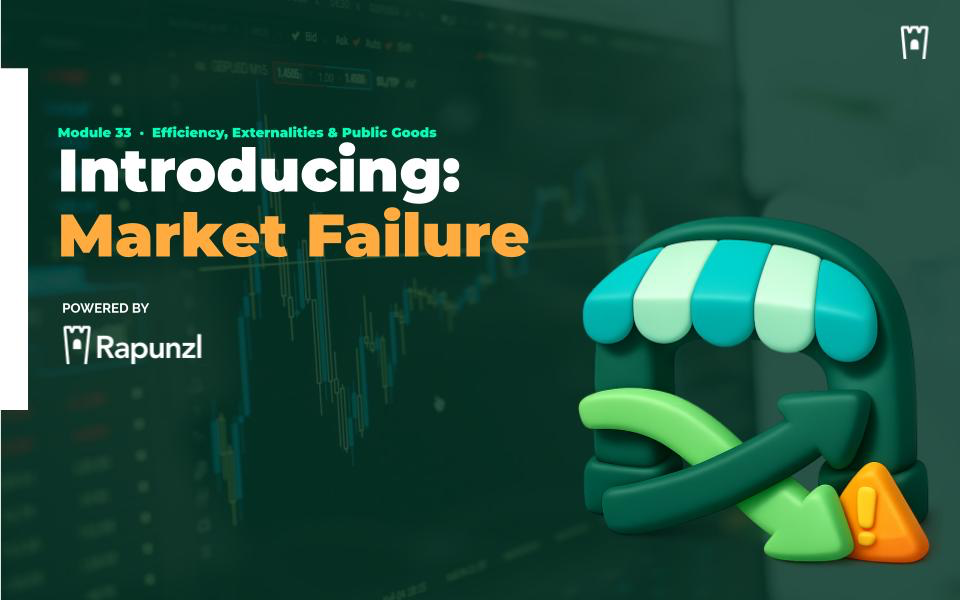 Week 4Market FailureCEE Standard 66 activities · 3 articles · 12 assessment itemsEssential question: When does a free market fail to produce what is best for society as a whole?
 Week 5The Role of GovernmentCEE Standard 76 activities · 4 articles · 16 assessment itemsEssential question: What should government do when markets fail — and when should it stay out?
 Weeks 6–7Work, Trade & Technology in the Modern EconomyCEE Standards 8–106 activities · 4 articles · 18 assessment itemsEssential question: What determines what people earn, why nations trade, and how is technology rewriting both?
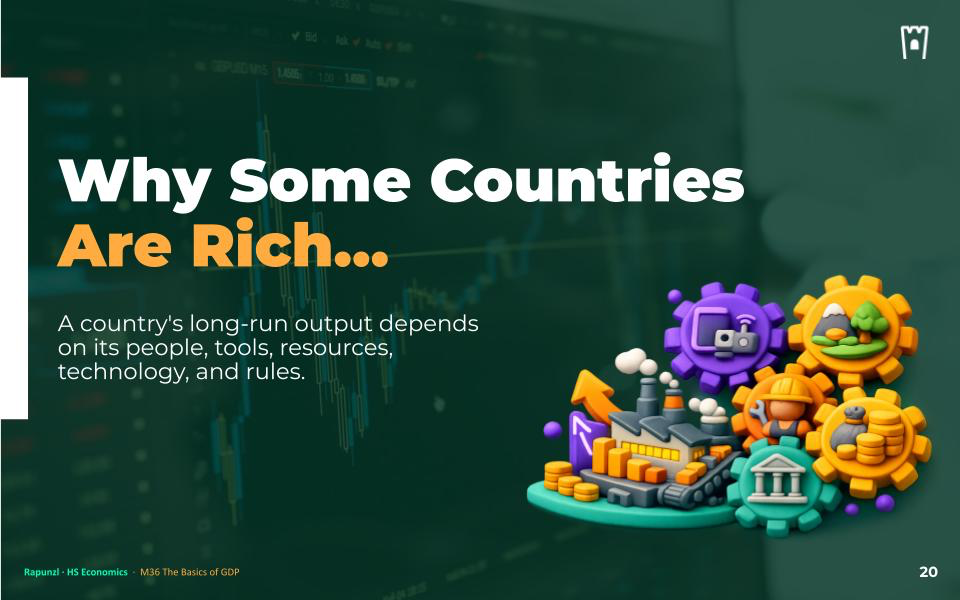 Week 8The Basics of GDPCEE Standard 116 activities · 3 articles · 12 assessment itemsEssential question: How do we measure the size of an entire economy — and what does the number leave out?
 Week 9Unemployment & Economic GrowthCEE Standards 12–166 activities · 4 articles · 16 assessment itemsEssential question: How do we know if an economy is using its people well and growing — and why does it rise and fall?
 Week 10Money, Banking & Interest RatesCEE Standards 13–146 activities · 4 articles · 16 assessment itemsEssential question: What is money really, and how does the price of borrowing shape the whole economy?
 Week 11Inflation & Monetary PolicyCEE Standards 15–176 activities · 4 articles · 16 assessment itemsEssential question: Why do prices rise, who does it hurt, and how does the Federal Reserve try to keep it in check?
 Week 12Fiscal Policy & TaxationCEE Standard 186 activities · 4 articles · 14 assessment itemsEssential question: How does the government use taxing and spending to steer the economy — and what does it cost?
Can it stand alone or blend into personal finance?
Both. Every module is self-contained, so the same content works as a dedicated economics course or as economics coverage inside an existing personal finance class.

Anchored in 18 CEE economics standards
The course covers every CEE Voluntary National Content Standard in Economics: all 18 standards and their 126 high school benchmarks, each mapped to a specific module and week.
See the full benchmark-level crosswalk
Detailed Step-By-Step Presentation Guides
These comprehensive personal finance and investing resources ensure teachers can effectively guide students through complex financial concepts while encouraging critical thinking and active participation.

A Personal Finance Curriculum Aligned With All State Standards
Get in touch with us to receive a roadmap for Rapunzl's state and national standards alignment, curriculum access, and login credentials for the simulator.
Gamified Learning To Increase Personal Finance Engagement
This increases student motivation by fostering a deeper understanding of subjects with hands-on activities and a real-time investment simulator, aiding in the development of critical thinking, problem-solving, and collaboration skills.

Rapunzl's curriculum is hosted through Google Cloud

Get In Touch With Rapunzl
Whatever the reason, we’d love to connect and share our insights after spending over 1,000 hours teaching financial education in high schools across the country.
Book a call, drop us a note and let’s connect.
High school economics course FAQ
Yes. The course spans ten modules over 12 weeks, which fits a standard high school semester with time left for review and final exams. It covers microeconomics in the first half (scarcity, markets, market failure, the role of government) and macroeconomics in the second (GDP, unemployment, money and banking, inflation, fiscal policy).
Yes, and many teachers do. Each economics module is self-contained, so you can pull individual modules, like Money, Banking & Interest Rates or Inflation & Monetary Policy, into a personal finance course where they fit naturally. Every module is tagged to both CEE economics standards and Jump$tart personal finance strands to make that mapping easy.
The course targets high school students in grades 9 through 12. The benchmarks it covers are the high school (H-level) benchmarks from the CEE Voluntary National Content Standards in Economics.
Yes. Students apply what they learn in Rapunzl's simulated investing platform, the same simulator used by 100,000+ students since 2018. Concepts like markets, interest rates, and inflation stop being abstract when students watch them move real stock prices in their own simulated portfolios.
Yes. The course covers all 18 CEE Voluntary National Content Standards in Economics and their 126 high school benchmarks. The full benchmark-level crosswalk is published on our economic standards alignment page, where curriculum directors can read exactly which module teaches each benchmark.